
Máté Ternyik: From Dailies to Finishing
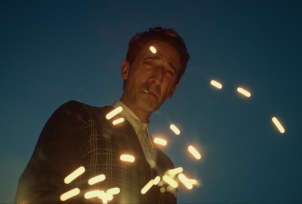
The winners of the 2025 FilmLight Colour Awards were announced during EnergaCAMERIMAGE in Toruń in November. Colourist Máté Ternyik’s work on The Brutalist earned him the top honour in the feature film category — a project defined by its scale, boldness, and deep technical experimentation.
Ternyik described the recognition as profoundly meaningful, emphasising how closely he has followed the Colour Awards.
“I’ve followed the nominees and winners of the FilmLight Colour Awards since its inception, always excited for the cutting-edge work that is presented here year after year,” says Ternyik. “Not to mention the honour of having my work be put in front of the members of the jury, all of whose artistry I have followed with awe over the years, learning from and being inspired by what they bring to this profession that is so rapidly progressing and expanding these days.”
End-to-end collaboration
Ternyik wasn’t originally slated to handle the full colour grade for the film—he had come on board solely as the dailies colourist. But very quickly, his work caught the eye of both the DoP (Lol Crawley, BSC) and the director (Brady Corbet), who were struck by how effortlessly he understood the look and emotional tone they were chasing. What began as a short-term role evolved into a seamless, end-to-end collaboration that ultimately shaped the film’s final visual identity.
“You know, when we first met Máté, he was our dailies colourist for The Brutalist, and within a very short period of time, Brady and I turned to each other and said ‘hey, we should just get him to do the whole movie – he’s nailing it’,” says cinematographer Crawley. “That is a rare thing, and very lucky for us to have someone producing such beautiful dailies that would also work on the final movie. It was a very seamless and valuable transition to have this.”
“The Brutalist wasn’t only one of the greatest creative and technical challenges of my career,” says Ternyik, “but thanks to the close collaboration with Lol and Brady, it was a project I feel I got to pour my best efforts into – from first camera tests to reviewing release prints. I’m very proud of the images we were able to bring to life.”
Pushing boundaries
Ternyik was involved in the process from the earliest stages of testing.
“I was involved with the project pretty consistently for a year and a half,” adds Ternyik. “During the shoot Lol and Brady came into the suite at least every other day to screen and grade dailies, where we found a lot of pleasure in trying things, testing solutions and informing the following days decisions on-set. This is my preferred way of working in general, as I think colour grading offers an incredible amount of opportunities for innovation as it is, but this can be a hundred times more true if the colourist gets to be involved and inform the process not only when finishing the project but while the shoot is happening and the creation of the images is unfolding day by day.
“Together we pushed the limits of low exposures and celebrated the looks we found at the edges of film’s technical tolerance. In return it allowed us to extract the deepest, richest, darkest, moodiest colours and contrasts that would not have been possible purely in the final grade.”
A monumental vision
The process of selecting the look itself was lengthy and extremely thorough.
“When Brady and Lol shared their vision with me, I already knew that it would be unlike anything I’ve seen in recent memory,” adds Ternyik. “It’s monumental, painterly, with a nod to vivid romantic and surreal oil on canvas, as well as to electrifying shocks of large panes of colour both on canvas and screen.”
“The look we achieved was unique in a more technical sense also, not only shooting on VistaVision and presenting in 70mm – which lent the film a sense of visual grandeur – but through Lol’s bold approach to using, and artfully abusing, analogue technology,” adds Ternyik. “We extensively tested ways I could support him in the grade to push-process and underexpose film, use available light and practical sources by finding ways to correct the unwanted characteristics of these methods, while celebrating the aspects of the resulting images we all found visually striking.”
“While we had a comprehensive overview of art and cinema to nail down the best ways to communicate the narrative, what really stood out to me was the way the architecture set the visual tone,” explains Ternyik. “Not only is it featured as subject, but in a sense it is an aesthetic vehicle, so we had to look carefully at form, texture, light, and shadow, and how they shift moods, colours, and the people living out their story within them and in their vicinity.
“Some of the most memorable moments to me in the film are scenes where the images are shaped by the light, colour, space, and texture of architecture and its materials like marble, concrete, wood, metal. And how they come to life through human presence and touch on screen.”
Artistic and technical experimentation
For Ternyik, the most challenging part was also the most rewarding – bringing together the artistic vision with the technical side of experimenting with the medium.
“One could argue that’s always a challenge, but what made this project so exciting was Brady and Lol’s willingness to experiment with everything and anything possible with this format and medium,” says Ternyik. “I can get obsessive with pushing the envelope of what’s technically possible to create unusual results, and while this is a time-consuming and deeply collaborative effort, it’s also what is most exciting to me.
“We presented the film in 70mm and 35mm prints alongside digital releases, and it was our goal to inject the digital versions of the film with as much of the life of analog prints as we could. We aimed to make the prints as pristine as possible, and give the digital releases a sense of life, imperfection, and timelessness without looking fake or distracting.
“It was a very welcome and electrifying challenge,” concludes Ternyik.
A lasting collaboration
”I like to nail the image as much as I possibly can in camera,” says Crawley. “I certainly hope people have seen enough of my work to know that I don’t play it safe. So, what was great about having Máté as a collaborator is that he understood where we wanted to sit the negative. When you’re not playing it safe your printer lights can come in low, you can get that dreadful phone call from the lab saying there’s an issue with the exposure, but having that close collaboration with Máté on this movie reassured me. He knew what the aesthetic of the movie was and we knew he could pull us back if we went too far. He knew where we were trying to sit the film, and it meant that we could all be bold together.”
“Máté, you’re a true collaborator, you have a wonderful eye, and you will fight alongside us to protect the intention of the photography,” concludes Crawley. “But you are also a truly kind and gentle soul. What a wonderful achievement. Congratulations again.”